
As online idn play technology continues to evolve, many players are drawn to platforms that emphasize accessibility and performance. A reliable situs idn poker generally offers intuitive navigation, secure account protection, and a wide selection of card games. These features help users focus on strategy and entertainment while enjoying a consistent gaming experience across different devices.
Many gaming enthusiasts search for a trusted link idn slot that offers stable connectivity and uninterrupted access to their favorite games. Fast-loading pages, responsive servers, and user-friendly features contribute significantly to player satisfaction. By prioritizing performance and accessibility, the link slot qris creates a comfortable environment where users can focus on enjoying entertainment without unnecessary technical obstacles or delays.Access to reliable data macau lottery updates allows users to make informed observations based on verified information. The platform emphasizes clarity, speed, and transparency, ensuring that every published result is easy to review. For many visitors, comprehensive result macau resources serve as an essential reference point when exploring historical records and recent draw activity.
Paul Ryan - Insider Trading
Summary
The Original Story
On August 11, 2012 a website called The Richmonder published an article claiming that Congressman Ryan had made trades to buy and sell bank stocks on the same day that he had attended a meeting on the upcoming financial crisis with Federal Reserve Chairman Ben Bernanke, Treasury Secretary Hank Paulson, and Congressional leaders such as Speaker Pelosi. The claim was based off of publications of Congressman Ryan's financial disclosure forms taken from OpenSecrets.org and put into a more readable format by Brad DeLong. The accusation was that Congressman Ryan emerged from the meeting with those leaders and sold stocks in banks he believed to be weak and purchased stocks in banks he was told were strong. Specifically, he sold stock in Wachovia, Citigroup and J. P. Morgan on September 18 and bought shares in Paulson’s old firm, Goldman Sachs.
Debunked
On the 13th, not long after the original story broke, TPM.com came forward claiming that the story had been debunked based upon statements from the Romney campaign. This debunked claim was based on three items:
- the trades were not individual stock trades, but trades made as part of an index that trades big blocs of stocks according to preset formulas - the Russell 1000 Index;
- the meeting took place in the evening, after markets were closed, so the meeting could not have played a role in Ryan’s trading decisions; and
- the stocks were traded within a trust over which Ryan had no direct authority.
Genesis of Story
While the original fervor over the story has died down, it has not gone away completely. The blogger that originally broke the story has come forward to note that he merely found an entry on Congressman Ryan's wikipedia page noting potential insider trading in 2008 and followed the documentation there to OpenSecrets.org. That wikipedia page has since been cleared of information related to that topic.
The Situation on September 18, 2008
It is important to note that no one was unaware of the financial crisis on September 18. It is false to assert that Congressman Ryan was somehow unaware of the problems in the financial industry on the morning of September 18 and then reacted to news given to him in that meeting. The market had gone down all year. On the 16th, the market had begun to collapse due to an adjustment by the Reserve Primary Fund, and the Fed had to inject a great deal of capital into the system and insure accounts up to $250,000.
Analysis of Congressman Ryan's Trades
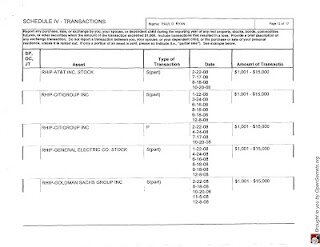
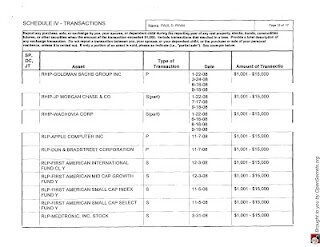
Congressman Ryan's financial disclosure forms show that on September 18, 2008, he did indeed sell stock in Wachovia, Citibank, and JP Morgan and purchase stock from Goldman Sachs. This is consistent with claims of reacting to the news fo a financial crisis as both the Treasury Secretary and Federal Reserve Chairman are Goldman Sachs alumni so that bank would likely fair well in any bailout. However, the records also show that he purchased Citigroup stock later in the year and sold at least some Goldman Sach's stock. In fact, throughout the year there were a number of trades made concerning these stocks with no apparent attempt to gain seek out and hold the best stock.
Unfortunately, the requirements of the disclosure forms is very broad and all of these purchases and sells are only noted as between $1,001 and $15,000. There may have been a substantial shift of funds to Goldman Sachs, but that simply cannot be proven or disproven in the disclosure forms.
The Timing Issue
While there does not seem to be evidence of insider trading, the explanations put out by the Romney campaign are not consistent. It is true that the trades on September 18, 2008 took place during the day and the meeting in question took place in that evening - after the markets were closed. However, those attending the meeting would have been made aware of it during the day. There would have been plenty of time to make the trades after becoming aware that a meeting was planned to address the issue. The assertion that Congressman Ryan was unaware of events to take place that evening within enough time to plan for them is not realistic.
On the other side, no one was unaware of financial trouble on the morning of Septemeber 18, 2008. Most of the major moves in the markets came on the 16th and 17th and early on the 18th. The idea that Congressman Ryan believed the financial markets were stable at some point in the morning and then changed his mind after being made aware of a meeting is not realistic either.
The Index and Fund Issues
The explanation put forth by the Romney campaign was that the trades were made as part of a larger fund and as a result of Russell 1000 Index are not consistent with Congressman Ryan's disclosure forms. The trades in question clearly involved individual stocks and not a larger fund. Trades involving larger funds are shown in the disclosure form and those transactions are obvious. A rebalancing to address Russell 1000 Index changes is also not consistent with those trades.
Loss Harvesting
To explain the somewhat erratic behavior of Congressman Ryan's trades, a theory put forward via blogger comments has been gaining traction. This theory holds that Congressman Ryan was not involved with the trades, but the Romney campaign is also not being truthful about the transactions. The theory is that Ryan's accountant was trading stocks within the financial industry in an effort to both remain within the industry and lock in losses for tax purposes.
Financial industry stocks had fallen all year. To show a loss in stocks for tax purposes, Congressman Ryan's accountant sold those stocks at low points throughout the year. However, the accountant expected a rebound in the sector and wanted to remain within the financial industry, so he purchased other stock in that sector at the same time he sold his stock at low points. By doing these two things, the accountant was able to remain within the financial industry to take advantage of the eventual rebound, and still take advantage of the losses for tax purposes. This is completely legal.
Original Story
On August 11, 2012 a blog called TheRichmonder.com published a story noting that Congressman Paul Ryan made several trades relating to banks on September 18, 2008 - the same day that he attended a meeting with Federal Reserve Chairman Ben Bernanke, Treasury Secretary Henry Paulson, and Congressional leaders such as Speaker Pelosi. The topic of that meeting was the poor situation in a number of banks, the possible banking crisis, and the possible need for legislaiton to help those institutions or a bailout.
Not long after that story broke, that blog became very popular. Eventually, a writer from theexaminer.com named Jerel Wilmore came forward to claim that is was in fact his blog. In doing so, he noted that after Congressman Ryan was selected as the VP candidate, he looked at his wikipedia page and found some inference to questionable trades made in 2008. He then looked at the financial disclosure forms available from OpenSecrets.org and wrote the story in question. Since that time, wikipedia has been altered to remove the references he followed.
Stock Trades
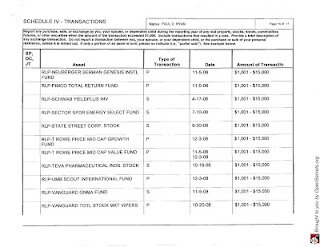
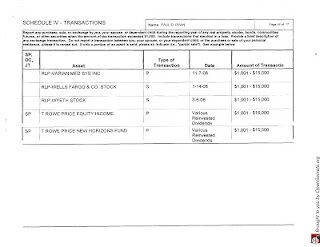
Congressman Ryan's disclosure forms show that he was very active in trading stocks relating to banks during 2008. His trades relating to Wachovia, Goldman Sachs, Citigroup, Wells Fargo, and JP Morgan Chase are shown below in the same format as displayed on those forms. It is of importance to note the "RHIP" preceeding the name of the asset in most columns. These letters stand for Ryan-Hutter Investment Partnership, the vehicle used to sell or purchase the stock. Some additional transactions are shown for comparison purposes. These transactions include those relating to larger funds.
The S or P in the "Type of Transaction" column denotes a sell or purchase respectively. The date column lists all the dates that the particular stock or fund was sold or purchased. Any given stock or fund may have been bought or sold several times and each date is included under the respective S or P. The financial disclosure rules require the amounts to be broken into large brackets. This is why the amount of the transaction is between $1,001 and $15,000.
The disclosure form shows that Congressman Ryan sold stock in Citigroup, JP Morgan Chase, and Wachovia on the day of the meeting relating to the financial crisis (9-18-08). He also purchased stock in Goldman Sachs on that date.
| SP, DC, JT | Asset | Type of Transaction | Date | Amount of Transaction |
| RHIP-CITIGROUP INC | S(part) | 1-22-08 3-24-08 6-16-08 8-18-08 9-18-08 12-8-08 |
$1,001 - $15,000 | |
| RHIP-CITIGROUP INC | P | 2-22-08 4-24-08 7-17-08 10-20-08 |
$1,001 - $15,000 | |
| RHIP-GOLDMAN SACHS GROUP INC | S(part) | 2-22-08 8-18-08 10-20-08 11-5-08 12-8-08 |
$1,001 - $15,000 | |
| RHIP-GOLDMAN SACHS GROUP INC | P | 1-22-08 3-24-08 6-16-08 9-18-08 |
$1,001 - $15,000 | |
| RHIP-JP MORGAN CHASE & CO | S(part) | 1-22-08 7-17-08 9-18-08 |
$1,001 - $15,000 | |
| RHIP-WACHOVIA CORP | S(part) | 1-22-08 6-16-08 8-18-08 9-18-08 |
$1,001 - $15,000 | |
| RLP-WELLS FARGO & CO. STOCK | S | 1-14-08 | $1,001 - $15,000 | |
| RLP-PIMCO TOTAL RETURN FUND | P | 11-5-08 | $1,001 - $15,000 | |
| RLP-VANGUARD GNMA FUND | S | 11-5-08 | $1,001 - $15,000 |
Rebuttal of Story
On August 13, 2012 TPM - TalkingPointsMemo.com - ran a story claiming that the story that Congressman Ryan had traded bank stocks with knowledge of the financial crisis had been debunked. That claim was based largely on a statement provided by the Romney for President campaign. The relevant section of the TPM article is shown below. However, the debunking claim can be broken down into three assertions:
- The meeting in question took place in the evening of September 18, after trading closed for the day and therefore Congressman Ryan could not have traded on information that he had not yet received
- The trades were part of a Russell 1000 index and were automatically done as part of a preset formula
- At the time of the trade, the index was held in a partnership that Ryan had no authority to make trades
Addressing the Russel 1000 Issue and Larger Fund
As noted in the TPM article, the statement put out by the Romney campaign asserted that the trades were part of Russell 1000 Index. However, the financial disclosure forms show that these trades were not part of a larger mutual fund and were carried out by the Ryan-Hutter Investment Partnership. Note that in the financial disclosure forms there are a number of these larger funds being trade, such as the PIMCO and Vanguard funds. However, the trades in question were not part of a larger fund.
Situation on September 18, 2008
On September 16, 2008, the Reserve Primary Fund, a large money market mutual fund, lowered its share price below $1 because of exposure to Lehman debt securities. This resulted in demands from investors to return their funds as the financial crisis mounted.
On Thursday Sept 18, 2008, at 11am the Federal Reserve noticed a tremendous $550 billion draw-down of money market accounts in the U.S.,in the matter of an hour or two. The Treasury opened up its window to help and pumped a $105 billion of liquidity into the system. It was equivalent to an electronic run on the banks. They decided to close the operation, close down the money accounts and announce a guarantee of $250,000 per account so there wouldn't be further panic.
If they had not done that, their estimation is that by 2pm that afternoon, $5.5 trillion would have been drawn out of the money market system.
Addressing the Timing Issue
Lynn Parramore at AlterNet wrote an article noting some issues with the timing of the trades by Congressman Ryan and the claim that the meeting in question took place after the markets closed and therefore he could not have traded on that knowledge. Specifically, it is noted that although the meeting took place in the evening, the scheduling of that meeting took place during the day. The mere fact that the meeting was scheduled and the purpose of it was obvious could have been enough to prompt the purchase of stock in Paulson's old firm - Goldman Sachs.
Loss Harvesting
A theory proposed by a commenter named "Cynic" on one of Brad DeLong's original posts on the issue notes that while there may not have been insider trading, the Romney campaign is being disengenious about what actually happened. He proposed that Congressman Ryan's accountants may have been practicing a perfectly legal practive called loss harvesting.
Financial Disclosure Forms
References
[1] Website: Slate.com Article: Paul Ryan's Bank Stock Trading Author: Matthew Yglesias Accessed on: 08/21/2012
[2] Website: The Richmonder Article: Paul Ryan traded on insider information to avoid 2008 crash Author: Staff Accessed on: 08/21/2012
[3] Website: The Richmonder Article: Romney campaign lied in response to Ryan insider trading story Author: Staff Accessed on: 08/21/2012
[4] Website: Delong.typepad.com Article: YES, PAUL RYAN'S FLACKS SNOOKERED BENJY SARLIN: REPUBLICANS LIE, ALL THE TIME, ABOUT EVERYTHING BLOG Author: Brad DeLong Accessed on: 08/21/2012
[5] Website: AlterNet.org Article: Revealed: Romney Campaign’s Attempts to Deny Paul Ryan’s Insider Trading Don't Add Up Author: NA Accessed on: 08/21/2012
[6] Website: CNBC Article: Paul Ryan's Unfortunate Bank Stock Trades Author: John Carney Accessed on: 08/21/2012
[7] Website: DeLong.typepad.com Article: RYAN'S TRANSACTIONS IN INDIVIDUAL BANK STOCKS IN 2008 Author: Brad DeLong Accessed on: 08/21/2012
[8] Website: TalkingPointsMemo.com Article: Paul Ryan Insider Trading Rumor Quickly Debunked Author: Benjy Sarlin Accessed on: 08/21/2012
[9] Website: TheExaminer.com Article: Romney campaign lied in response to Ryan insider trading story Author: Jerel Wilmore Accessed on: 08/22/2012
[10] Website: AboveTopSecret.org Article: Paul Ryan traded on insider information to avoid 2008 crash Author: NA Accessed on: 08/22/2012
[11] Website: Wikipedia Article: Global financial crisis in September 2008 Author: NA Accessed on: 08/22/2012
[12] Website: ZeroHedge.blogspot.com Article: How The World Almost Came To An End At 2PM On September 18 Author: Tyler Durden Accessed on: 08/22/2012
[13] Website: TheDailyBeast Article: Was Ryan Involved In Insider Trading? Ctd Author: Andrew Sullivan Accessed on: 08/22/2012